

Book Pairings
When reading one book helps you understand another

Do you find that reading one book helps you experience another more fully?
Earlier this year, I read Philip Ryken’s excellent little book The Messiah Comes to Middle-Earth: Images of Christ’s Threefold Office in The Lord of the Rings. Little did I know that I’d soon get to revisit the topic of Christ as prophet, priest, and king: my book club meets this week to discuss Jonty Rhodes’s equally excellent (and equally little) book Man of Sorrows, King of Glory.
Man of Sorrows, King of Glory reads a bit headier than The Messiah Comes to Middle-Earth. I must confess, I appreciated having eased my way into the topic via the wading pool of Middle-earth1 rather than diving into the deep end straightaway!
Ryken (the president of Wheaton College) initially delivered his material in a series of lectures at Wheaton’s Marion Wade Center, exploring Christ’s trifold office via Tolkien’s characters of Frodo, Gandalf, and Aragorn.
Comparatively, Rhodes (a minister in Leeds, England) approaches the topic more academically—but also musically: lyrics from Philip P. Bliss’s 1875 hymn “Hallelujah! What a Savior”2 became chapter headings and a base framework for his book.
Christ as our prophet, priest, and king is by no means a light topic (no matter how short the book may be). But I found that approaching it from a couple different angles helped me grasp it more deeply. Wading pool and diving board both got me in the pool, and my experience was more complete because of both.3
What other books do this?
Of course, there are boatloads of books written on any given topic. But not all of them lend themselves to reading concurrently-ish, or just have that magical overlap that make our brains’ neural pathways light up. Authors, perspectives, and even simply time can make all the difference.4

The gospels
If we want to go for the big guns right away, the gospels come to mind. I love how each of the gospel writers emphasize something different about the life of Christ!5
Other biblical books
Matt Whitman suggests pairing Job and Ecclesiastes, Jonah and Nahum, and Matthew and Hebrews. He writes, “[At] first glance, [they] might not seem like natural matches; but when read in tandem, something remarkable happens: The one enriches and rounds out the other, and you come away understanding both more deeply.”6 7
Books by the same author
I love when authors interweave characters from one series or book into another. (Susan May Warren is the queen of this in Christian fiction.) But who really came to mind, even before Warren, is Daniel James Brown, author of The Boys in the Boat and Facing the Mountain: The books are set within a couple decades of each other, and an easter-egg8 footnote in Facing the Mountain tips off the attentive reader to a small living space that was used not only by a character in that book, but Joe Rantz, spotlighted in Boys in the Boat.
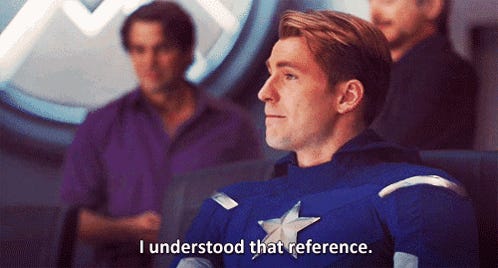
I could easily spiral to Marvel-level easter eggs—but in this instance, I’m really thinking about the 30,000-foot level … books that simply approach a given topic from a different angle and give the reader that lightbulb “aha” moment. (Although Daniel James Brown’s nod to Joe Rantz in Facing the Mountain definitely let me channel Captain America.)
And more …
The Gospel Coalition suggests some interesting book pairings for new graduates that intrigue me (even though I am very much not a new graduate). Russ Ramsey/James K. A. Smith seems natural; Miroslav Volf/Tim & Kathy Keller surprised me, enough that I may check them out just to see if I agree!
What say you?
What books have you read on a given topic that enhanced your appreciation or understanding of a topic? I’d love to hear!
Tolkien opts for the lowercase “earth” in “Middle-earth,” so I’ll follow his lead.
Also known by its first lines, “Man of Sorrows, what a Name.”
Trying (clearly not very) hard to resist the urge to reference Golpalott’s Law. Again. The sum of the experience is greater than its individual parts (Meagan’s translation).
Today I learned that this is called a tetramorph: “a symbolic arrangement of four differing elements, or the combination of four disparate elements in one unit. The term is derived from the Greek tetra, meaning four, and morph, shape.” The entire Wikipedia article on this is fascinating.
Whitman, Matt. “Bible Book Pairings: Three Twin Books That Are Richer When Read Together.” NIV Bible, April 27, 2026. https://www.thenivbible.com/blog/job-ecclesiastes-jonah-nahum-matthew-hebrews/.
See, Whitman gets Golpalott’s Law too.
Today I also learned that “easter egg” (when referring to hidden meanings and not, you know, literal Easter eggs) can have “Easter” either lowercase or capitalized.
Love this so much! I’m listening to Emma M. Lion audiobooks right now and she is constantly referencing so many books and authors. It is delightful!
I love seeing those connections in Scripture. The Bible reading plan I use must be intentionally connecting specific OT and NT books because I’ll be reading and then just in awe how the NT reading often connects so meaningfully to the OT text… which is God’s intent of course, but I love when I see it! ❤️
A recent one for me is reading Jennifer Trafton’s biography on Lilias Trotter, If Only We Could See and seeing a reference over and over to a George MacDonald novel, the Seaboard Parish, which Lilias read as a teenager. So of course, I needed to get The Seaboard Parish! ☺️
I was just thinking about this idea the other day...book pairings. My thought came after I found out that Joan Didion read Conrad's Victory before starting a novel so I thought it would be cool to read Victory with A Book of Common Prayer. But of course the list of interesting pairings is probably incredibly long...and can probably be overdone, but I just really like the idea of reading two authors who were in conversation textually somehow.